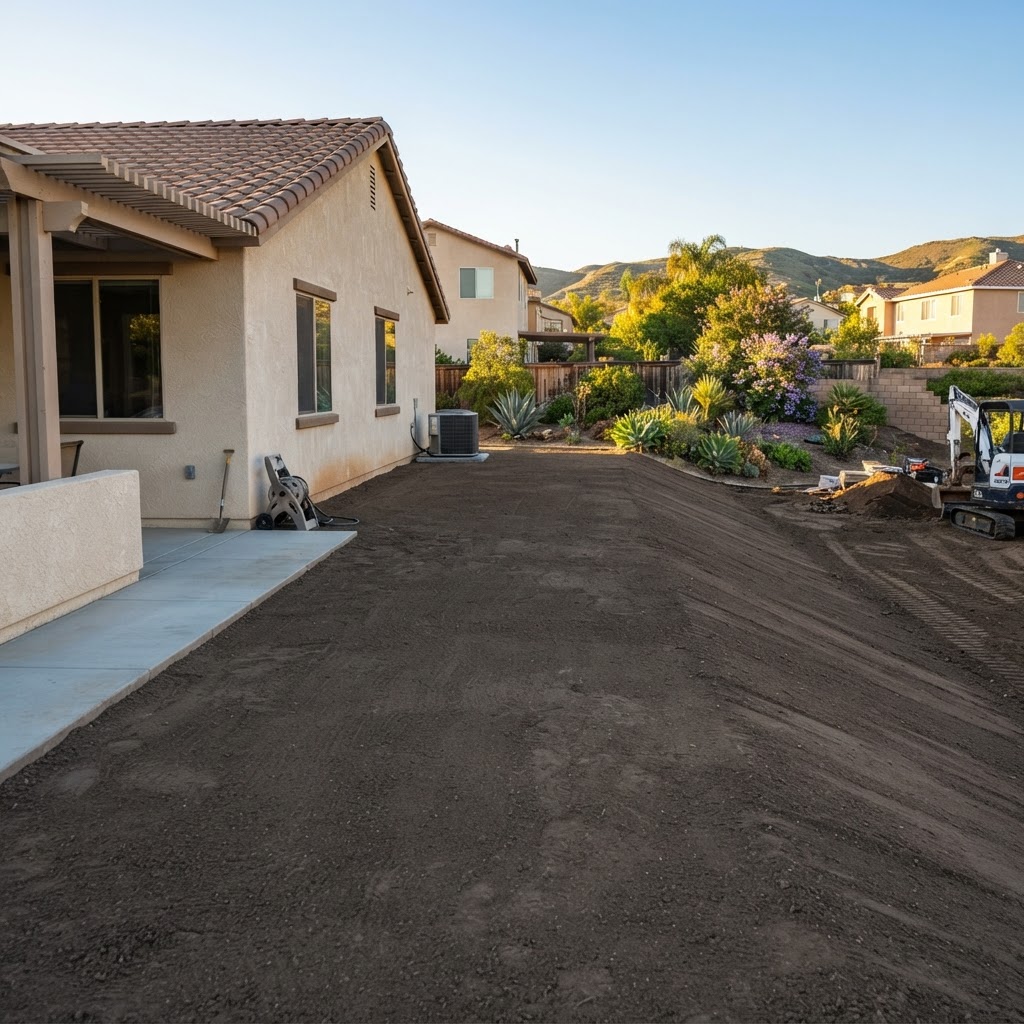
Most San Diego homeowners don't think about the dirt around their house until water shows up where it shouldn't. A puddle that sits against the stem wall for two days. A damp spot in the garage. Mud washing across the driveway every time it rains. Nine times out of ten, the problem isn't the gutters or the plumbing. It's the grade.
Grading and drainage work go hand in hand. The ground around your home has to be shaped so water moves away from the foundation, and there has to be somewhere for that water to go once it does. Get both right and rain stops being something you worry about.
What "Grading Property Around Your House" Actually Means
Grading is shaping the soil so it slopes in the direction you want water to travel. Around a house, that direction is always away from the foundation.
The residential building code calls for the ground to fall at least 6 inches within the first 10 feet out from the foundation. That's roughly a 5% slope. It doesn't look like much, but it's enough to keep rainwater from sitting against your footings and soaking into the soil underneath them.
When the ground slopes toward the house instead, that's called negative grading. It's one of the most common drainage problems we see in East County, especially on older homes where years of landscaping, settling, and added topsoil have slowly flattened or reversed the original grade.
Signs You Need Foundation Grading or Drainage Repair
- Water pools within a few feet of the house after it rains
- Soil is noticeably higher against the house than it is a few feet out
- Mulch or dirt is piled up against the siding or stucco weep screed
- White, chalky residue (efflorescence) on foundation walls or garage slab
- New or growing cracks in the slab, stem wall, or patio
- Erosion channels cutting through planters or across the yard
- Mud or standing water on the driveway after storms
If you're seeing more than one of these, it's worth having a grading contractor take a look before the next big rain.
Why It Matters More in San Diego Than People Think
We don't get rain often, but when we do, it tends to come all at once. A dry yard can't absorb a heavy storm, so the water runs wherever the ground sends it. Parts of East County also sit on clay-heavy soils that swell when they get wet and shrink as they dry out. That cycle puts real stress on foundations and slabs, and poor grading makes it worse by soaking the soil right next to the house.
This winter is a good reason to get ahead of it. Fixing drainage in the fall is a lot easier than fixing it in January with water already sitting at the door.
How We Regrade Around a Foundation
Every property is different, but most residential grading and drainage jobs follow the same basic steps:
- Walk the property and shoot the grades. We find where water is coming from, where it's collecting, and where it can safely be sent.
- Rough grading. We cut down high spots, fill low spots, and pull soil away from the foundation to re-establish positive slope.
- Drainage where grading alone won't do it. On tight side yards or flat lots, there isn't always room to slope the ground enough. That's where french drains, area drains, swales, or downspout lines carry the water out.
- Compaction. Loose fill settles, and settled fill eventually slopes right back toward the house. We compact as we go so the grade holds.
- Finish grading. The final pass leaves a smooth, even surface ready for landscaping, rock, or hardscape.
We also handle driveway grading for gravel and dirt driveways that wash out, rut up, or send water toward the garage.
Can You Regrade Around Your Foundation Yourself?
For a small low spot, sometimes. Adding a few wheelbarrows of soil and raking it out to slope away from the wall can help. Just keep at least 4 to 6 inches between the soil and the bottom of your siding or stucco.
Where DIY usually goes wrong is scale. Moving several yards of dirt by hand, getting the slope right across a whole side of the house, and compacting it so it doesn't sink by spring are jobs that go faster and last longer with the right equipment. And if the fix needs a french drain or a trench to the street, that's a job for an experienced excavation crew.
Grading and Drainage FAQ
Q: How much does grading and drainage work cost?
A: It depends on how much soil needs to move, access to the work area, and whether drains are part of the fix. We give free estimates so you know the number before any work starts.
Q: Do I need a permit for yard grading?
A: Small residential regrading usually doesn't need one, but larger jobs that move significant soil or change how water drains onto neighboring property can. We'll tell you up front if your project needs a permit.
Q: How long does grading around a house take?
A: Most residential jobs take a few days depending on the size of the area and whether drains are being installed. We'll give you a timeline with your estimate.
Q: What's the difference between rough and finish grading?
A: Rough grading sets the overall shape and slope. Finish grading is the final, smooth layer that's ready for landscaping or hardscape.
Need Grading and Drainage Near You?
Dirt Wurx handles residential grading, drainage, french drains, and driveway grading across San Diego County, including Santee, El Cajon, Lakeside, Poway, La Mesa, and Blossom Valley. If water is collecting around your house, we'll come out, find the cause, and fix it right.
Call 619-817-7941 or request a free estimate. Lic #967559.