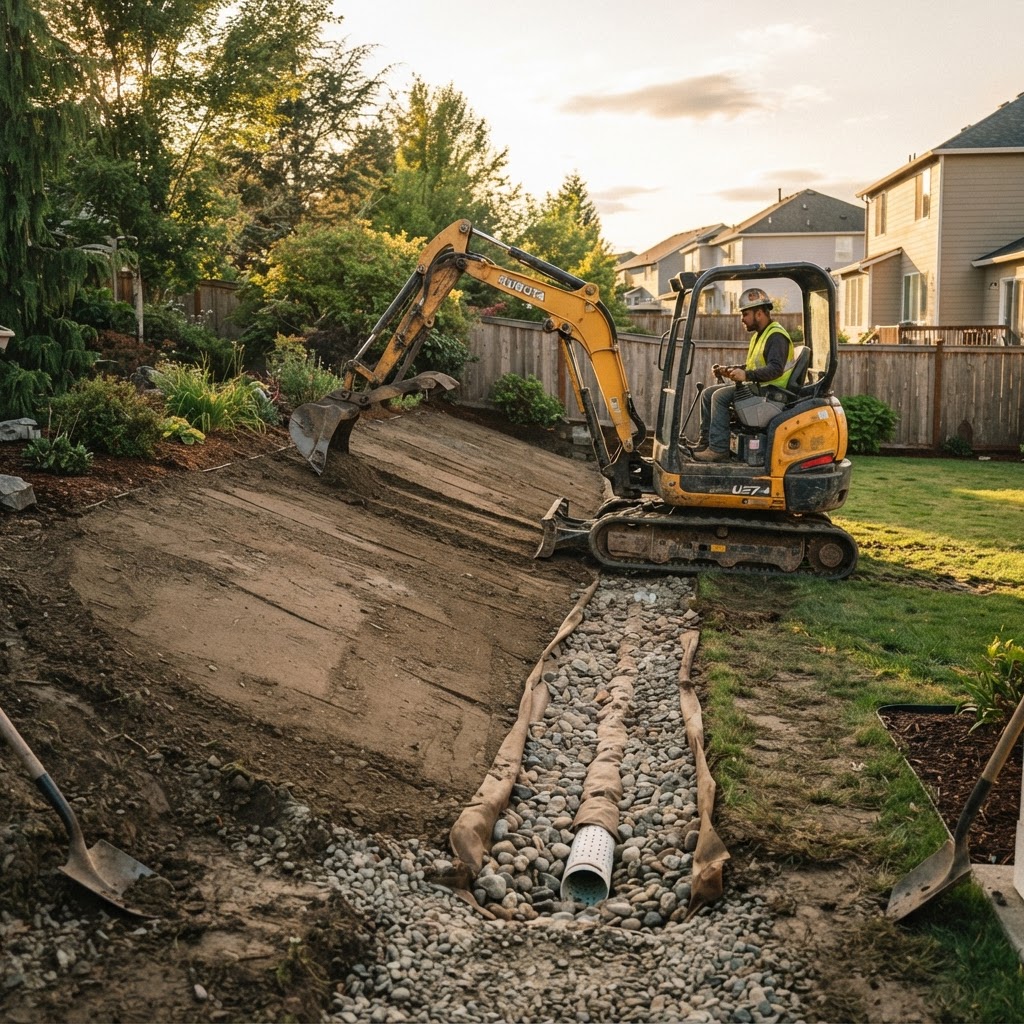
If you have typed "grading and drainage" into a search box, you are not alone. Most people use the terms interchangeably, and contractors often bundle them together, which does not help. But grading and drainage are two different things, and knowing which one your yard actually needs can save you real money.
What Grading Actually Is
Grading is shaping the land itself. Instead of adding a product or a pipe, grading changes the slope of your yard so gravity moves water where you want it to go.
The industry standard for homes is simple: the soil should drop about six inches over the first ten feet away from the foundation, roughly a 2 to 5 percent slope. Beyond that first ten feet, the yard should keep a consistent grade toward a safe outlet like the street, a swale, or a drain. When the grade is right, most rain never needs a drain at all. It just keeps moving.
What a Drainage System Is
Drainage systems are structures that collect and pipe water away. The common ones:
- French drains. A gravel-filled trench with a perforated pipe that catches subsurface and surface water and carries it away.
- Catch basins and area drains. Grated boxes set at low points that collect standing water and pipe it out.
- Channel drains. Long surface grates, usually across driveways and patios, that intercept sheet flow.
- Downspout drains. Pipes that take roof runoff underground and away from the house instead of dumping it at the wall.
Drainage manages water that grading alone cannot handle, like roof runoff during a downpour or flow from ground you cannot reshape.
Why the Difference Matters
Here is the mistake we see most often: a homeowner installs a drain to fix a wet yard, but the yard still funnels water to the wrong place, so the drain never sees it. A drainage system without grading is a bucket under a crooked roof line. It only works if the water happens to arrive at the bucket.
The reverse is also true. Plenty of "drainage problems" are really grading problems, and simple regrading fixes them with no pipe at all. That matters for your wallet, because regrading is often cheaper than a drain install and there is no pipe to clog ten years from now.
How to Tell Which One You Need
- Water pools in the middle of the lawn, away from the house. That is usually a grading fix. Reshape the low spot and give the water a path out.
- Water sits against the foundation. Foundation grading comes first. A drain may follow, but soil slope does the heavy lifting.
- Downspouts dump at the base of the wall. Downspout drains plus a regrade of the soil below them.
- Water arrives from an uphill neighbor. You may need both: a swale or catch basin to intercept it and grading to move it out.
- Water sheets across a patio or driveway you cannot regrade. That is a job for channel drains or area drains.
When You Need Both
The most reliable yard water solutions use grading and drainage together. Grading moves the bulk water where you want it, and the drains catch the remainder, especially roof runoff during fast, heavy storms like the ones El Niño years bring. A contractor who quotes a drain without ever checking your grade is selling you half a fix.
The Dirt Wurx Approach
We look at the land first. Every estimate starts with how your lot actually drains, then we build a plan that fixes the cause, not just the symptom. If you have a wet yard, soggy lawn, or water against the house, call Dirt Wurx SD at 619.817.7941 or read more about our drainage and grading services.